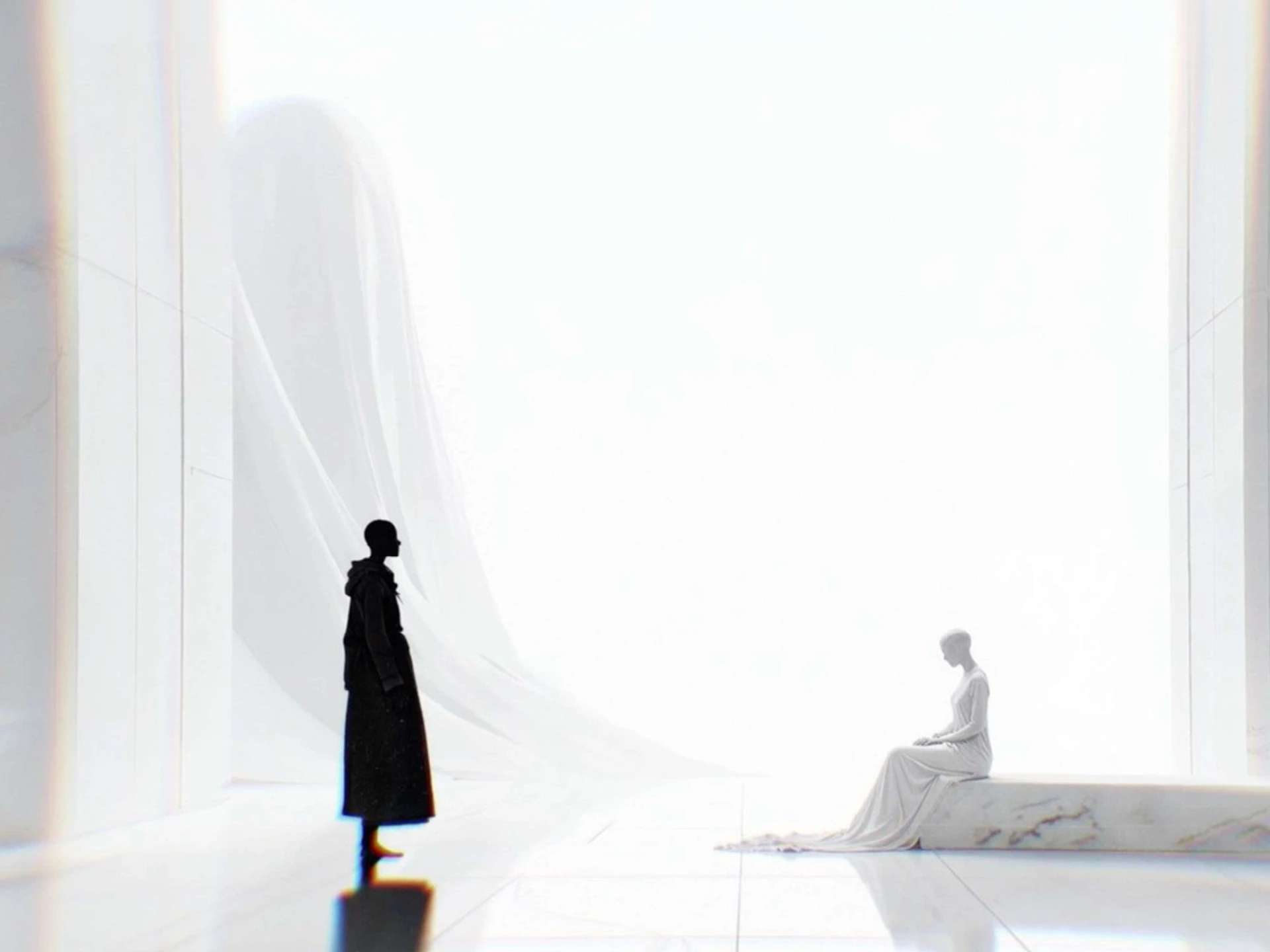
The Tale of Colors
In a time when Black and White governed the extremes of design and perception, there existed a unique object that united them: the Mirror of Balance. It was an ancient artifact created by an unknown artisan who had understood that both colors, though opposites, could not exist without each other. Its frame was made of a dark metal that absorbed light, as if forged from Black’s shadows, while its surface was pure, radiant, like White’s first ray of light.
The mirror was not just a decorative object; it had a purpose. It reflected not what the eyes could see, but what the soul needed to understand. It was, in essence, a bridge between the absoluteness of black and the infiniteness of white, showing how they complemented and defined one another.
The Gathering of Colors
The story begins in the Palace of Shadows, Black’s home. In its dark halls, where light was barely a whisper, the Mirror of Balance remained hidden in a secret room, protected by the veil of the unknown. Black had guarded the mirror for centuries, afraid of what it might reveal if someone looked at it for too long. But one day, White, curious and determined, arrived at the palace.
“Let me see it,” White requested, his voice like the echo of a cold breeze in a cavern. “I want to understand what you keep in this place.”
Black hesitated. “This mirror does not just reflect,” he replied. “It reveals. And what it reveals may be more than you wish to know.”
White insisted. He had heard that the mirror could show how the absoluteness of black and the clarity of white could coexist, and he wanted to understand this connection to bring balance to his own Sanctuary of Light.
Finally, Black agreed, but on one condition: they would look together.
What the Mirror Reflected
When they both stood before the mirror, it did not reflect their figures as they had expected. Instead, it showed a completely white, dazzlingly empty room. At its center stood a black, monolithic table that seemed to absorb all the clarity of the space. The combination was perfect, unsettling, and sublime at the same time.
Black observed how his presence did not darken the white but defined it. White saw that his purity was not complete without something to give it weight, depth. It was a reminder that both were necessary, not as opposites, but as parts of a whole.
“It’s beautiful,” White murmured.
“It’s true,” Black said.
But the mirror did not stop there. The image shifted, showing fragments of both colors in constant motion, merging and separating like waves. They realized that balance was not a static state but an eternal dialogue between light and darkness, between the visible and the hidden.
The Mirror and the World’s Designs
After that experience, Black and White decided to use the mirror as a source of inspiration to transform the world of design. Black built a new room in the Palace of Shadows, where the dark lines of architecture now embraced light, allowing it to play on the surfaces. White redesigned a wing of his Sanctuary of Light, introducing soft shadows and textures that gave depth to his pristine spaces.
Together, they created a collection of works: furniture, fabrics, structures. A chair that combined white marble and black ebony, each part fitting together like a puzzle. A white silk dress with a barely visible black lining, like an intimate secret. A lamp that emitted warm white light but projected dark geometric shadows.
The Mirror of Balance became the symbol of their collaboration. Though it returned to its room in the Palace of Shadows, its influence continued to shape the worlds of design and perception, reminding everyone that there is no clarity without darkness, no light without shadow.
By J. David M. Jofre